Is SAP S/4HANA Worth the Cost for Finance Teams? A CFO's Perspective
Breaking down the true cost, hidden risks, and financial returns of SAP S/4HANA from a CFO’s lens
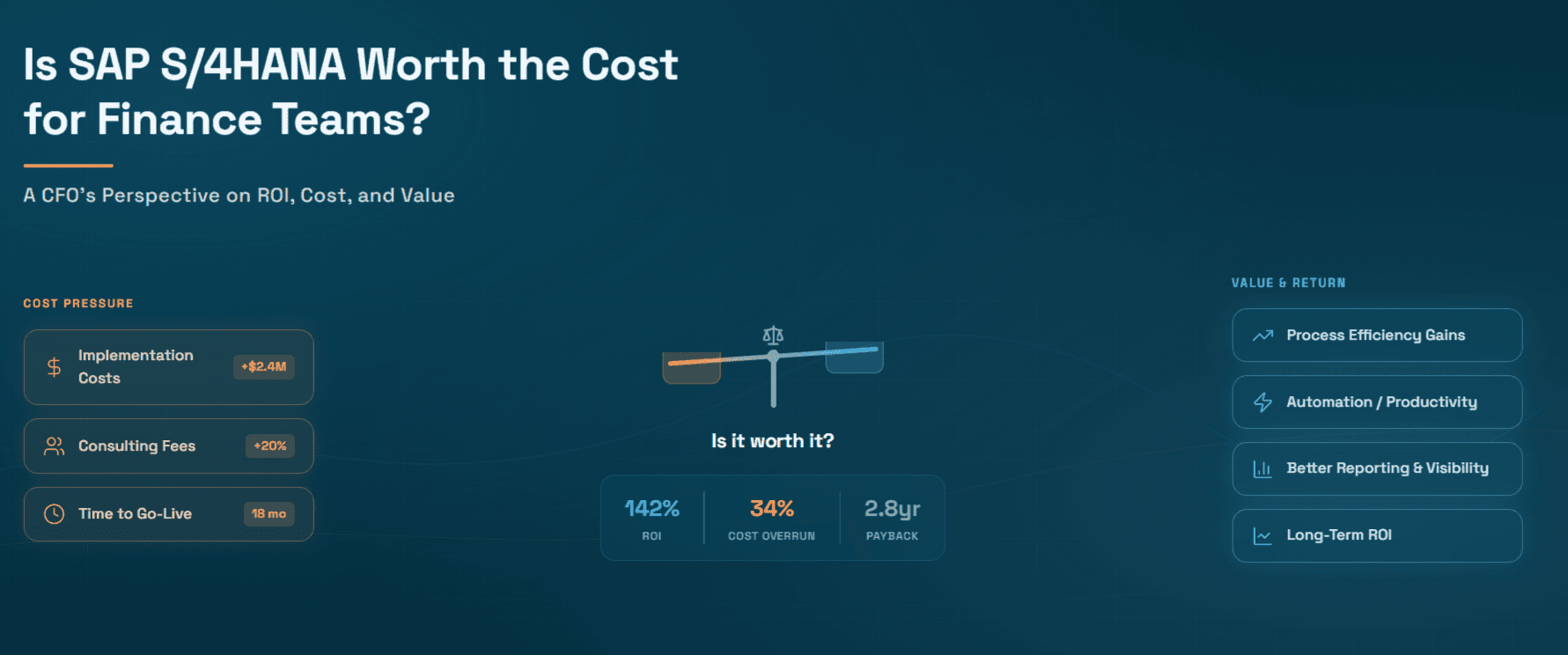
SAP S/4HANA is one of the most significant investments a finance organization can make. At its best, it promises a real-time financial platform, streamlined processes, and a single source of truth for the enterprise. At its worst, it can become a multi-year implementation sinkhole that consumes capital, disrupts operations, and still requires an army of consultants to keep running.
For a CFO evaluating or mid-way through an S/4HANA journey, the question is always the same: is this actually worth what we're paying for it?
This blog unpacks the ROI of S/4HANA from a finance team's perspective what you get, what you don't get, where the real gaps are, and how modern AI co-pilots like those from Hyperbots are filling those gaps to finally deliver the finance value that S/4HANA alone has struggled to provide.
What SAP S/4HANA Promises Finance Teams
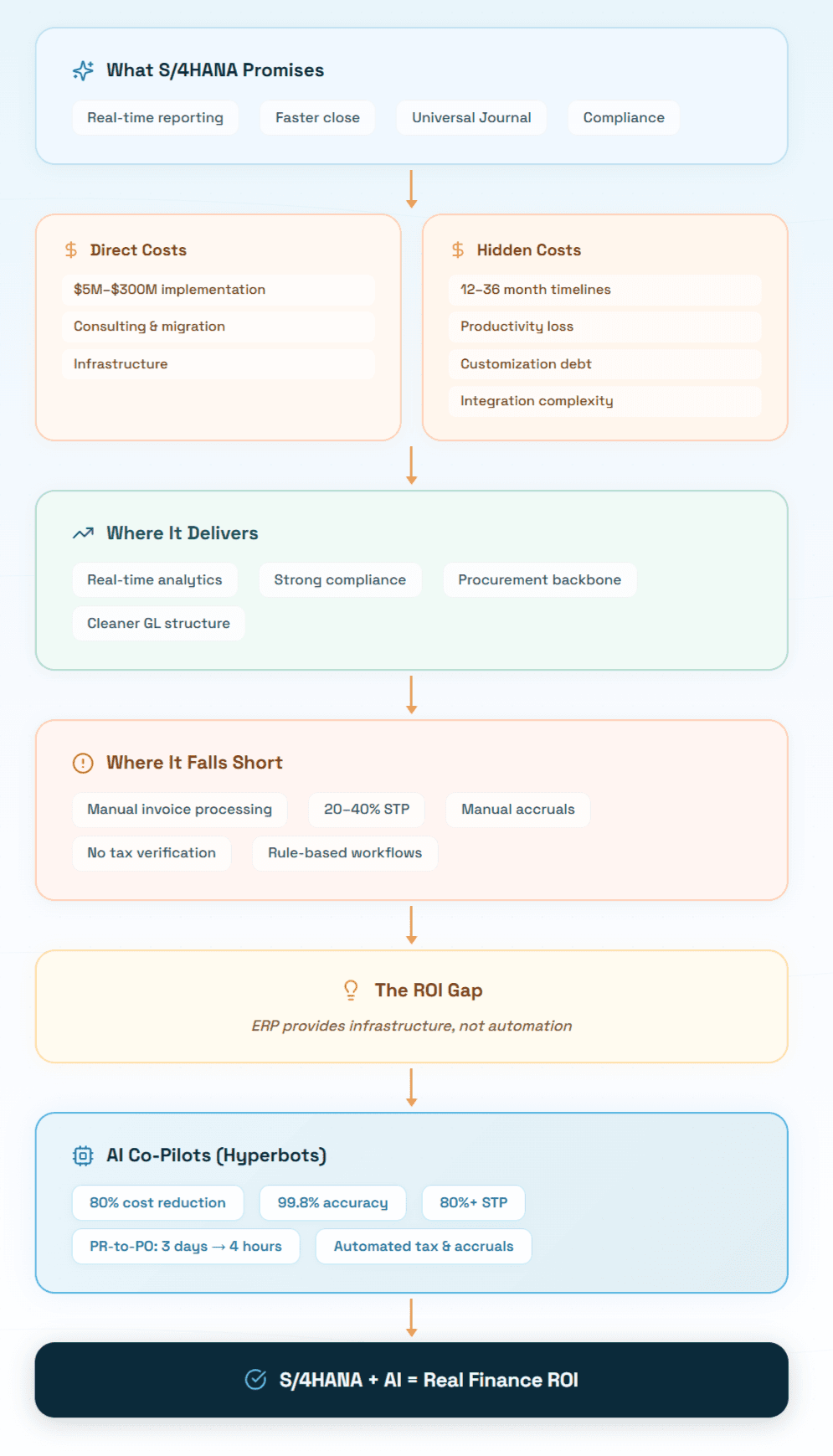
SAP S/4HANA, released as the successor to SAP ECC, was designed around the in-memory HANA database to enable real-time analytics and simplified data models. For finance teams, the pitch was compelling:
Faster period-end close driven by real-time data
Universal Journal that eliminates reconciliation between FI and CO modules
Embedded analytics that remove the need for separate BI layers
Simplified Chart of Accounts management
Improved compliance and audit readiness
Modern UX through SAP Fiori
These are meaningful improvements over ECC. The Universal Journal alone, which merges multiple financial ledgers into a single table, reduces the complexity of multi-dimensional reporting significantly. Finance leaders who have completed migrations generally confirm that the analytical horsepower of S/4HANA is genuinely superior.
But the real question is not whether S/4HANA is good ERP technology. It clearly is. The question is whether the total cost and disruption of getting there is justified by the finance value that actually materializes on the other side.
The True Cost of SAP S/4HANA for Finance: What CFOs Rarely Anticipate
Let's be honest about what a full S/4HANA implementation costs. Large enterprises routinely see total program costs in the range of $50M to $300M or more, depending on scope. Mid-market organizations implementing SAP S/4HANA via RISE or the Public Cloud edition still typically face $5M to $30M in total program spend when professional services, data migration, training, and organizational change management are included.
Direct Costs
The license or subscription fee is only the start. The major cost categories in a real S/4HANA program include:
Implementation and consulting fees: SAP system integrators whether Accenture, Deloitte, IBM, or regional boutiques, typically bill $250 to $500 per hour. Large programs run 100,000 to 500,000 consulting hours. That number should give any CFO pause.
Data migration: Migrating legacy ERP data involves GL balances, vendor master records, open POs, historical transactions and that’s consistently one of the most expensive and time-consuming phases. Clean, validated data is a prerequisite. Few organizations have it.
Infrastructure: On-premise or private cloud SAP HANA infrastructure is expensive. Even on RISE with SAP (the managed cloud offering), total infrastructure costs are material.
Training and change management: Finance teams trained on ECC or legacy systems need significant re-skilling. User adoption issues are one of the most common post-go-live failure modes.
Post-go-live support: Hypercare periods, stabilization, and the ongoing cost of Basis administration, functional support, and enhancement projects can equal 15–20% of the original implementation cost annually.
Hidden Costs That Erode ROI
Beyond the direct costs, there are several categories of cost that rarely appear in the business case but consistently materialize:
Extended timelines: SAP implementations routinely take 12 to 36 months for large programs. Every month of delay consumes budget and delays the realization of expected finance value.
Productivity loss during cutover: AP teams, procurement teams, and GL accountants experience significant productivity degradation during and immediately after go-live, often for 3–6 months.
Technical debt from customizations: Every deviation from the SAP standard creates future upgrade risk. Organizations often inherit a heavily customized system that becomes expensive to maintain.
Integration costs: S/4HANA rarely stands alone. Integrating with third-party systems such as payroll, expense management, CRM, EDI partners, banking adds considerable cost and complexity.
For a balanced view of how ERP costs should be evaluated versus the business value delivered, Hyperbots' ERP implementation guide for 2025 provides a useful framework for realistic cost-benefit thinking before committing to a program.
Where SAP S/4HANA Delivers Genuine Finance Value
Despite the costs, S/4HANA does deliver measurable finance value in specific areas. CFOs who have successfully implemented it point to the following genuine strengths:
Real-Time Closing and Reporting
The Universal Journal and HANA's in-memory processing genuinely accelerate period-end close for organizations with the discipline to configure it correctly. Trial balances, management reports, and variance analyses that previously required batch jobs running overnight can now be produced on-demand. For CFOs who need to shorten the close cycle to support faster business decision-making, this is real value.
Improved Compliance Architecture
SAP S/4HANA's compliance capabilities including document splitting, parallel ledger management for IFRS and GAAP, and robust audit trail architecture are mature and well-proven. Large, multinational organizations with complex statutory reporting requirements benefit meaningfully from these capabilities.
Procurement Foundation
SAP S/4HANA provides a solid transactional backbone for procurement including purchase requisition processing, three-way matching, and supplier invoice workflows. For organizations coming from fragmented, non-ERP procurement environments, this represents a step-change improvement.
That said, the native procurement workflows in S/4HANA are process-enforcing, not intelligent. They ensure that the right steps happen; they do not autonomously perform those steps. The difference matters enormously when you're evaluating actual productivity gains for your finance team. For a clear view of how AI complements ERP systems rather than replacing them, the distinction is worth understanding carefully.
GL Coding and Chart of Accounts Management
The simplified data model in S/4HANA makes GL coding more consistent and supports better Chart of Accounts governance. Organizations that use this as an opportunity to rationalize their COA typically see cleaner financial reporting. For guidance on making the most of this, SAP-specific resources on Chart of Accounts and GL coding for SAP are worth reviewing during any S/4HANA migration program.
Where SAP S/4HANA Falls Short for Finance Teams
This is where honest conversation gets important. SAP S/4HANA is a comprehensive ERP platform but it is not an intelligent finance automation platform. The gap between these two things is wide, and it directly impacts the ROI of S/4HANA for day-to-day finance operations.
Invoice Processing Remains Manual
Despite S/4HANA's sophisticated matching capabilities, invoice processing in most SAP environments still requires significant manual effort. Invoice receipt, data entry or OCR capture, exception handling, coding disputes, and approval chasing remain largely manual or semi-automated activities. This is why AP teams in S/4HANA environments frequently look no different in size from AP teams in legacy ERP environments.
Procurement Approval Workflows Are Rule-Based, Not Intelligent
S/4HANA enforces procurement workflows but the intelligence layer is thin. PR-to-PO cycles that should take hours still take days when approvers are unavailable, when policy validation is manual, or when vendor data mismatches require human intervention. The PR-to-PO cycle compression from 3 days to 4 hours that AI-native platforms achieve is simply not possible with SAP's native automation alone.
Accruals Are Still Largely Manual
Month-end accruals in S/4HANA remain one of the most manually intensive activities in the finance calendar. Identifying unbilled liabilities, calculating accrual amounts, creating journal entries, and reversing them in the following period all require significant accountant time. S/4HANA provides the posting infrastructure, but not the intelligence to automate the discovery and calculation process.
Vendor Management Requires External Tools
SAP's vendor master management is robust as a data repository but lacks autonomous capabilities for vendor onboarding, identity verification, and ongoing compliance monitoring. Organizations typically need vendor portal solutions, onboarding workflows, and communication tools that operate alongside S/4HANA rather than within it.
Sales Tax Verification Is Not Native
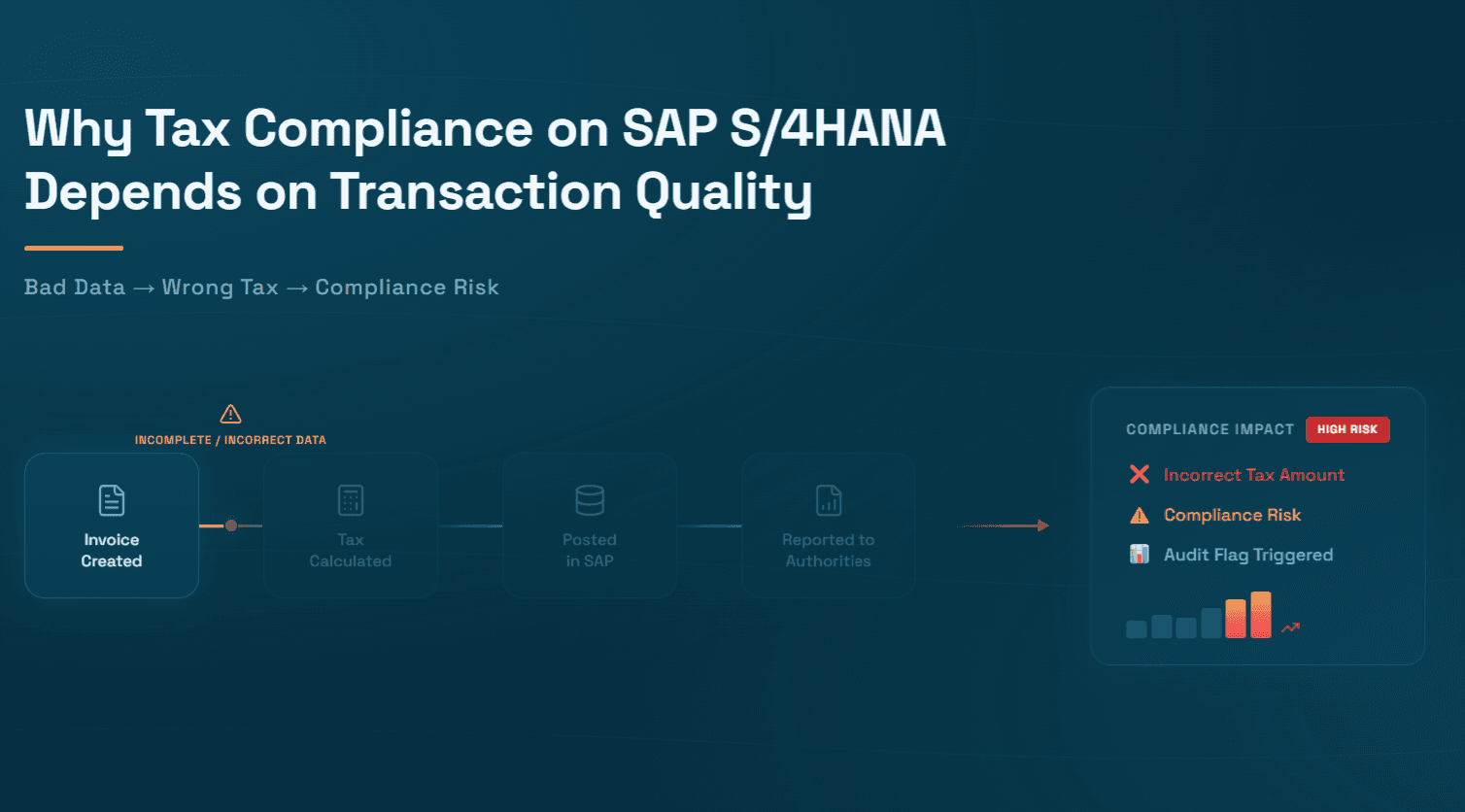
Sales and use tax determination in S/4HANA typically requires integration with external tax engines like Vertex or Avalara. Native tax verification capabilities are limited, and for organizations with complex multi-state or multi-jurisdiction exposure, the risk of tax leakage is real. A CFO at one company identified and eliminated $200,000 in annual tax leakage that their ERP had entirely missed.
The Straight-Through Processing Gap
Perhaps the most telling limitation of S/4HANA for AP operations is its straight-through processing (STP) rate for invoices. In practice, most SAP environments achieve 20–40% STP without significant additional automation investment which means 60–80% of invoices still require some form of manual handling. Why straight-through processing remains a major technology challenge despite years of ERP investment is a question that deserves serious examination.
How to Evaluate the Real ROI of S/4HANA for Finance
For CFOs building or pressure-testing an S/4HANA business case, the ROI of S/4HANA needs to be evaluated honestly across several dimensions.
Quantifiable ROI Components
Close cycle reduction: If your current close takes 10 days and S/4HANA gets you to 7, you have faster reporting, earlier decision-making, and reduced month-end overtime and that’s what it means to provide real value. Quantify it in FTE hours and analyst productivity.
Compliance and audit cost reduction: Reduced external audit fees driven by better documentation, audit trails, and financial controls are measurable. Fewer material weaknesses and restatement risks also reduce risk-adjusted cost of capital.
Consolidation of ERP landscape: If S/4HANA replaces 3–5 legacy systems, the total cost of ownership reduction is real and quantifiable. Fewer systems means lower licensing, infrastructure, and support costs.
Procurement process efficiency: If SAP S/4HANA introduces formal PR-PO workflows where none existed, the spend visibility and control benefits can be substantial. Maverick spending reduction is often the largest single source of procurement ROI.
The ROI Gap: What S/4HANA Doesn't Complete
The critical insight for any CFO doing this analysis is that S/4HANA provides the infrastructure for finance value but it does not automatically deliver the operational automation that drives the headline ROI numbers used to justify the investment. To realize the full promise, most organizations need an intelligent automation layer that sits on top of S/4HANA and actually executes the work.
This is precisely where AI co-pilots for finance and accounting have emerged as the critical complement to ERP systems delivering the productivity and accuracy gains that S/4HANA alone cannot.
The AI Co-Pilot Layer: Unlocking the Finance Value S/4HANA Promises
This is where the conversation about the ROI of S/4HANA gets genuinely exciting. Organizations that pair S/4HANA with purpose-built AI co-pilots are achieving the productivity improvements that the original S/4HANA business case promised but couldn't deliver on its own.
Hyperbots has built the most comprehensive suite of AI co-pilots for finance and accounting automation, designed specifically to integrate with ERPs like SAP S/4HANA and to deliver measurable, production-grade results. Unlike generic automation tools, Hyperbots AI co-pilots are pre-trained on finance-specific data, configurable to company-specific policies, and capable of autonomous reasoning, not just rule execution.
The result: organizations achieve up to 80% reduction in operational costs and 99.8% accuracy in processes like invoice extraction and matching.
Hyperbots AI Co-Pilots for Procure-to-Pay (P2P)
Invoice Processing Co-Pilot
The Invoice Processing Co-Pilot is not an OCR tool. It is an end-to-end AI agent that autonomously handles invoice receipt from any channel (email, portal, EDI), extracts every field with near-perfect accuracy regardless of format, validates against POs and goods receipts, applies GL coding, routes for exception handling, and posts to the ERP, all without human involvement for the majority of invoices.
The real benefit is not just speed. It is the elimination of the human bottleneck in AP. An AP team that previously spent 60% of its time on data entry, coding, and chasing approvals is freed to focus on vendor relationships, exception investigation, and cash flow optimization. Extreme Reach, a real Hyperbots customer, achieved 80% straight-through processing and 99.8% accuracy and these are outcomes that SAP's native capabilities simply cannot match.
Capabilities include automated 3-way matching, duplicate detection, AI-driven GL coding, automated GL posting, and complete audit trails.
Procurement Co-Pilot
The Procurement Co-Pilot transforms the PR-PO cycle from a multi-day manual process into an autonomous, intelligent workflow. It extracts purchase requisition details from emails and documents, auto-fills PR fields using historical data and policy rules, validates against budgets and spending policies, routes for approval through configurable workflows, and generates and dispatches POs automatically upon approval.
The benefit for finance teams: the procurement cycle that previously consumed two to three days of coordination across requestors, managers, and AP teams can be compressed to four hours or less. Procurement automation ROI in this dimension is among the fastest payback categories in all of finance automation.
Vendor Management Co-Pilot
The Vendor Management Co-Pilot automates the full vendor lifecycle from initial onboarding through identity verification, compliance monitoring, and ongoing communication. Vendor onboarding that previously required manual data collection forms, back-and-forth email chains, and manual ERP data entry is replaced by an automated workflow that validates vendor data, verifies identity, flags compliance issues, and populates the SAP vendor master automatically.
The business benefit is not just time savings. It is fraud risk reduction. Many AP fraud schemes originate in the vendor onboarding process. Automated identity verification and anomaly detection during onboarding significantly reduce this exposure.
Payments Co-Pilot
The Payments Co-Pilot brings intelligence to payment decisions that SAP processes but does not optimize. It analyzes invoice due dates, available cash, vendor discount terms, and relationship priorities to recommend optimal payment timing by capturing early payment discounts where available, strategically deferring payments where beneficial, and flagging fraud anomalies before disbursement.
The financial benefit is direct and quantifiable. Capturing missed early payment discounts with even moderate invoice volumes can generate six-figure annual savings. The computation of cash savings from early payment discounts demonstrates this in concrete financial model terms.
Sales Tax Verification Co-Pilot
The Sales Tax Verification Co-Pilot addresses one of the most overlooked risk areas in AP automation such as incorrect sales and use tax on vendor invoices. The co-pilot automatically validates tax rates against jurisdiction rules, classifies line items using AI-driven tax category logic, flags overcharges and undercharges, and integrates with tax dictionaries for multi-state compliance.
For organizations with multi-state purchasing activity, the combination of avoided tax leakage and reduced audit exposure represents significant finance value that is almost never captured in the S/4HANA business case but absolutely should be.
Accruals Co-Pilot
The Accruals Co-Pilot is arguably the most transformational capability in the Hyperbots suite for finance teams that have invested in S/4HANA. It autonomously discovers accrual candidates such as goods received but not invoiced, services received but not billed, recurring expenses without POs and using this, the co-pilot calculates accrual amounts, creates journal entries, posts them to the ERP, and reverses them in the following period. All without a controller or accountant manually building the accrual schedule.
The month-end close impact is real: organizations using the Accruals Co-Pilot report significant reductions in close cycle time, fewer post-close adjustments, and improved accuracy of period-end financials. Transforming accruals with agentic AI describes this transformation in detail.
Hyperbots AI Co-Pilots for Order-to-Cash (O2C)
While P2P automation gets the most attention, Hyperbots' AI co-pilots extend equally powerful capabilities to the order-to-cash cycle.
Collections Co-Pilot
The Collections Co-Pilot automates accounts receivable collections workflows by prioritizing overdue accounts based on risk scores, generating and sending collection communications, escalating to appropriate team members, and tracking promise-to-pay commitments. Finance teams that previously managed collections through spreadsheet aging reports and manual email campaigns can transition to an AI-orchestrated process that increases collection rates while reducing DSO.
Cash Application Co-Pilot
The Cash Application Co-Pilot automates the matching of incoming payments to open invoices by handling partial payments, short pays, multi-invoice remittances, and unclear payment references with AI-driven reasoning. The benefit is a dramatic reduction in unapplied cash balances and the analyst time consumed in resolving payment matching exceptions, a problem that plagues most AR teams regardless of which ERP they're running.
Hyperbots Platform Capabilities: Transformational Impact Beyond Single Co-Pilots
What makes Hyperbots genuinely differentiated is not any single co-pilot, it is the platform architecture that makes them work together.
Multi-Agent Collaboration
Hyperbots uses a multi-agent AI collaboration model where specialized AI agents hand off work to each other across the P2P and O2C workflows. An invoice processing agent that identifies a pricing discrepancy automatically triggers a procurement agent to verify the PO terms, which triggers a vendor communication to resolve the dispute without human orchestration. This is the agentic AI model that finance leaders at CFO roundtables across the US are actively exploring and implementing.
Pre-Trained, Finance-Specific AI Models
Unlike generic AI tools that require months of training on your specific documents, Hyperbots' ready-to-deploy pre-trained models are trained on finance-specific data and can achieve high accuracy from day one. This is why Hyperbots customers go live in days rather than months which is substantiated by real customer outcomes.
Company-Specific Policy Configuration
Every Hyperbots co-pilot is configurable to company-specific policies such as the company’s approval thresholds, GL coding rules, matching tolerances, vendor classifications, and payment priorities. The AI doesn't just automate the generic process; it automates your process. This policy-driven AI approach is directly responsible for the 80% productivity gains that customers report.
Self-Learning and Continuous Improvement
Hyperbots co-pilots incorporate self-learning capabilities thus, improving accuracy over time as the AI learns from reviewer feedback and exception patterns. An AP operation that achieves 95% STP on day one can expect to reach 99%+ within months as the system learns the organization's specific patterns.
Explainable AI and Audit-Ready Transparency
One of the most important differentiators for finance teams and a direct contrast with black-box automation tools, is Hyperbots' commitment to explainable AI. Every decision the AI makes is logged with a rationale why an invoice was coded to a specific GL account, why a payment was flagged, why an accrual was booked at a specific amount. This makes Hyperbots inherently audit-ready and gives finance controllers the confidence to deploy autonomous AI in regulated environments.
Unlimited User Licensing
Unlike competing platforms that charge per seat, Hyperbots offers unlimited user licensing which means finance teams can deploy co-pilots across the entire organization without incremental per-user costs. This fundamentally changes the ROI model for enterprise-wide adoption.
Hyperbots ROI in P2P and O2C: Tangible and Intangible Gains
The following summarizes the measurable ROI outcomes Hyperbots delivers across its co-pilot suite:
Accounts Payable / P2P:
80%+ straight-through processing rate for invoices
99.8% invoice extraction accuracy
60–80% reduction in AP headcount requirements relative to invoice volume
PR-to-PO cycle compressed from 3 days to 4 hours
Early payment discount capture rate improved from under 30% to 80%+
Sales tax overpayments identified and recovered (six figures annually in documented cases)
Month-end close shortened by 30–50% through accruals automation
Order-to-Cash / O2C:
DSO reduction through intelligent collections prioritization
Significant reduction in unapplied cash through automated cash application
Reduced dispute cycle times through AI-driven customer communication
Intangible Benefits:
Finance team morale improvement as repetitive transaction processing is eliminated
Stronger vendor relationships through consistent, transparent payment communication
Improved audit outcomes through complete, explainable AI audit trails
Better risk management through fraud detection in both AP and AR workflows
Organizational scalability as Hyperbots handles growth in invoice and PO volume without proportional headcount growth
For a structured approach to measuring these returns, the ROI on AI-led automation in finance framework provides a practical model for building the business case.
How Hyperbots Integrates with SAP S/4HANA
A common concern when evaluating AI co-pilots alongside a major ERP investment is integration complexity. Hyperbots addresses this directly through its ERP integration architecture, which includes pre-built connectors for SAP S/4HANA, SAP Business One, and SAP Ariba.
The integration model is plug-and-play in design as Hyperbots maps to the SAP data model, syncs vendor master and GL code data, posts transactions directly to SAP ledgers, and reads PO and GR data for matching. There is no need to recode SAP customizations or alter the ERP configuration. Hyperbots operates as an intelligent layer on top of SAP, extending its capabilities rather than replacing them.
For organizations using SAP Business One, Hyperbots delivers 80% efficiency improvement and 98.8% accuracy, concrete metrics that translate directly into the ROI arithmetic that CFOs need.
Industry-Specific Finance Value: Manufacturing, Professional Services, and Retail
The ROI of S/4HANA varies significantly by industry and so does the incremental value that AI co-pilots add on top of it.
Manufacturing: SAP S/4HANA's manufacturing modules (PP, MRP) are strong, but invoice matching for high-volume, multi-line POs from production suppliers remains a major manual burden. Hyperbots' manufacturing-specific capabilities handle complex PO-heavy invoice matching at scale, with specialized logic for partial deliveries, blanket POs, and goods-in-transit scenarios.
Professional Services: In professional services environments, the challenge is matching invoices for time-and-materials services to open purchase orders, a scenario where traditional 3-way matching breaks down. Hyperbots handles matching for open-ended service contracts with purpose-built logic.
Retail and Distribution: Multi-entity organizations with high invoice volumes benefit from Hyperbots' multi-entity support by being able to manage separate approval policies, tax rules, and GL structures across subsidiaries without configuration overhead.
Across all industries Hyperbots serves, the pattern is consistent: SAP S/4HANA provides the transactional backbone, and Hyperbots AI co-pilots provide the intelligence layer that delivers the productivity gains.
SAP S/4HANA vs. The AI-Augmented Alternative: A Balanced Assessment
Let's be direct. For very large enterprises with complex multi-national ERP requirements, SAP S/4HANA is almost certainly the right foundation. The compliance architecture, multi-currency multi-entity support, and integration with SAP's broader ecosystem (Ariba, Concur, SuccessFactors) are mature and proven.
For mid-market organizations, the calculus is more complex. The cost and implementation risk of full S/4HANA may not be justified without a clear plan to also deploy the AI automation layer that converts the ERP investment into real day-to-day productivity. An organization that spends $10M on S/4HANA and still runs manual AP processes has not achieved the finance value that the investment was intended to deliver.
The most successful finance transformations follow a two-part model: S/4HANA or equivalent ERP as the system of record, and AI co-pilots as the autonomous execution layer. Neither alone delivers the full picture. Together, they create the finance function of the future, one where controllers focus on analysis rather than transaction processing, where cash is optimized in real time, and where audit readiness is continuous rather than month-end scramble.
Building the dream AI workspace for finance articulates this vision clearly from a CFO's perspective.
Making SAP S/4HANA Worth the Investment
The honest answer to whether SAP S/4HANA is worth the cost for finance teams is: it depends on what you build on top of it.
S/4HANA provides the right foundation, a real-time, compliant, integrated ERP that supports the data and process requirements of modern finance. But dramatically reduced operational costs, faster closes, higher accuracy, intelligent cash management, all of which are within a typical CFO’s expectations, requires an AI intelligence layer that SAP S/4HANA alone does not provide.
Hyperbots AI co-pilots are designed precisely for this purpose. They extend SAP S/4HANA with the autonomous execution capabilities that convert the ERP's process infrastructure into real operational productivity by reducing costs by up to 80%, achieving 99.8% accuracy, and delivering ROI within months rather than years.
For CFOs navigating the S/4HANA investment decision, the path to maximum finance value runs through both: SAP S/4HANA as the system of record, and Hyperbots AI co-pilots as the intelligent automation layer that makes it work the way the original business case promised.
To see what this looks like for your organization, request a personalized demo or explore the Hyperbots ROI calculators to model the impact on your specific finance operations.
Frequently Asked Questions (FAQs)
Q1: What is the typical ROI timeline for SAP S/4HANA?
Most large S/4HANA implementations take 3 to 7 years to reach full ROI when total program costs are included. Time-to-value is significantly extended by implementation complexity, data migration challenges, and the time required for user adoption to reach full productivity. Organizations that layer AI co-pilots on top of S/4HANA typically see incremental automation ROI within 3–6 months of co-pilot deployment, independent of the broader ERP program timeline.
Q2: Can Hyperbots AI co-pilots work with SAP S/4HANA?
Yes. Hyperbots has pre-built integration connectors for SAP S/4HANA that enable plug-and-play deployment. The co-pilots sync with SAP vendor master, GL, PO, and GR data and post transactions directly into SAP ledgers. Faster onboarding with Hyperbots ERP integration describes the integration acceleration approach in detail.
Q3: Is SAP S/4HANA necessary for AI-driven AP automation?
No. Hyperbots AI co-pilots are designed to work with any major ERP including Oracle NetSuite, Microsoft Dynamics, QuickBooks, Sage, and Deltek Costpoint. The AI intelligence layer is ERP-agnostic. That said, organizations running SAP S/4HANA benefit from the stronger underlying data infrastructure when combined with AI automation.
Q4: How does Hyperbots differ from SAP's own automation tools (like SAP Intelligent RPA)?
SAP's native automation tools are rule-based and template-dependent. They automate defined steps in defined formats. Hyperbots uses AI-native reasoning that handles variation, exceptions, and edge cases without templates. This is why Hyperbots achieves 99.8% accuracy across invoice formats that would break SAP's rule-based automation. The distinction between agentic AI and template-based OCR is fundamental to understanding the performance gap.
Q5: What finance value should a CFO expect from deploying Hyperbots on top of SAP S/4HANA?
Documented outcomes include: 80%+ STP on invoices, 99.8% extraction accuracy, PR-to-PO cycle compression from 3 days to 4 hours, significant early payment discount capture improvement, and month-end close acceleration through automated accruals. The Hyperbots ROI calculators allow CFOs to model these outcomes against their own invoice volumes, headcount, and payment terms.
Q6: How quickly can Hyperbots be deployed?
Unlike SAP implementation programs that run 12–36 months, Hyperbots co-pilots can be deployed and operational within days to weeks. Pre-trained models eliminate the lengthy AI training periods that other platforms require, and the ERP integration approach minimizes IT involvement. How pre-trained AI co-pilots transformed finance in days, not months documents this time-to-value advantage in concrete terms.
Q7: Does Hyperbots support multi-entity SAP environments?
Yes. Hyperbots is designed for multi-entity organizations thus supporting separate approval policies, GL structures, tax rules, and ledgers across subsidiaries within a single deployment.
Q8: What is the pricing model for Hyperbots?
Hyperbots operates on an unlimited-user licensing model, meaning organizations pay based on process scope rather than per-seat headcount. This makes enterprise-wide deployment economically viable in a way that per-user tools are not. One license, unlimited users, massive ROI explains the commercial model.